

Entities Map
The Entities Map page checks the JPA mapping of every entity in a Spring Boot instance and shows the associations that are mapped in a way that costs extra queries: eager fetching, List-backed @ManyToMany, cascade REMOVE or ALL, and unidirectional @OneToMany.
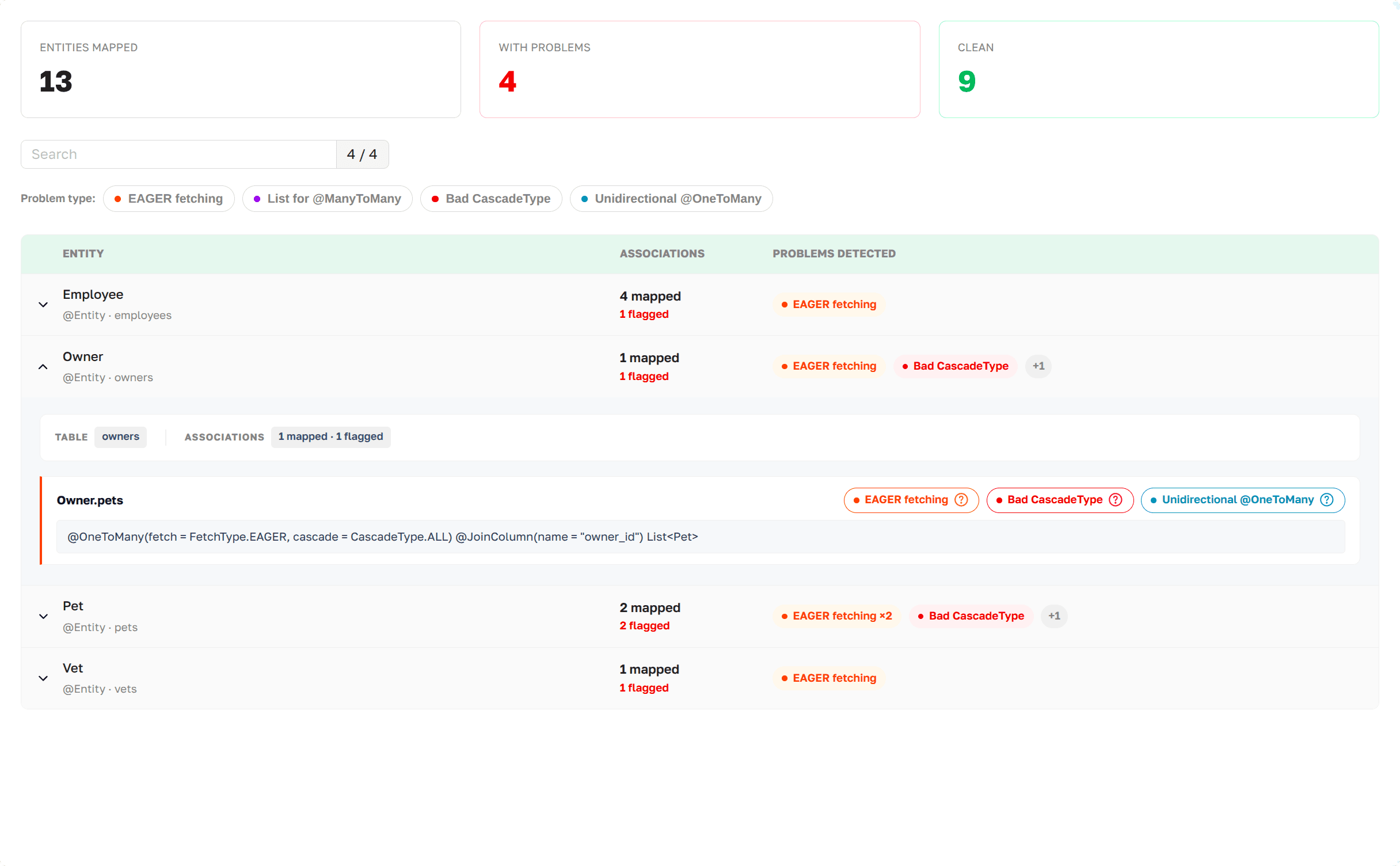
Entities Map as presented in Axelix UI
Mistakes in the mapping of JPA associations don't break the application. Instead, they cost extra queries and loads every time the entity is used, and they are easy to miss in code review. The Entities Map checks the mapping of all entities and shows where such mistakes are.
The page is read-only and available to every authenticated user: VIEWER, EDITOR, ADMIN, and SUPER_ADMIN can all open it. See Roles and authorities for the full role/authority matrix.
What the page shows
A summary on top shows how many entities the instance maps, and how many of them have problems and how many are clean. Below, the page lists the entities with problems.
Expand an entity to see:
- The table name from
@Table, or the entity name when@Tabledoesn't set one. - Each problematic association, for example
Owner.pets, with its problems. - The mapping of this association with the effective values, including defaults, for example
@OneToMany(fetch = FetchType.EAGER, cascade = CascadeType.ALL) @JoinColumn(name = "owner_id") List<Pet>.
When no entity has problems, the page says so instead of showing the list.
Detected problems
- EAGER fetching: The association is loaded every time the entity is read, whether or not the data is used. This
includes
@ManyToOneand@OneToOnewithout an explicitfetch, because JPA makes them eager by default. - List for @ManyToMany: A
@ManyToManybacked by aListmakes Hibernate clear and re-insert the whole join table on any change. - Bad CascadeType: On a
@OneToManyor@ManyToMany,CascadeType.REMOVEorCascadeType.ALLmakes Hibernate remove related records one by one, which results in N+1 queries. - Unidirectional @OneToMany: A
@OneToManywithoutmappedByneeds an extra join table or a separateUPDATEfor each record.
How it works
The Axelix Spring Boot Starter reads the application's JPA metamodel and checks each association. Unlike Transaction Control, the result doesn't depend on traffic: Axelix checks how the entities are mapped, not which queries have run. The page needs Hibernate in the application.
MCP Tools
AI agents can get the entities and their mapping problems through MCP, for the whole application or for one entity. See the MCP Tools catalog.
Properties
The Entities Map works together with transaction monitoring and is enabled by default. To turn it off, set
axelix.sbs.transaction.monitoring.enabled=false. See Transaction
monitoring
for details.